
Hermanus History Group (HIG) visit to Die Bron Primary School on 10th November 2025
December 5, 2025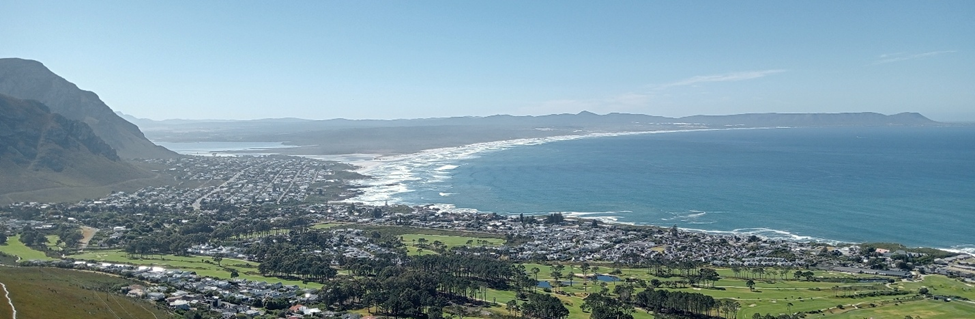
The beautiful Walker Bay coast along which Hermanus is situated is world-renowned for its fantastic land-based whale-watching opportunities and its unsurpassed fynbos floral kingdom. Strangely enough, few people know who the Walker was after whom the Bay was named, including most residents of Hermanus itself!
The quest to identify the man who sailed into this Bay around two centuries ago has gone on without success for some six decades at least, until now. What follows is a brief account of this wonderful story of historical research and discovery. Readers should note that several men by the name of William Walker are mentioned in this article as possible “candidates”, which could lead to confusion. For that reason, we have used suffixes after each name, e.g. “WW. “A”, “WW. “B”, etc.
In the beginning
The story begins in 2017 when Dr Robin Lee of the then Hermanus History Society (HHS) wrote an article on the origin of the name Walker Bay noting that in earlier books on the history of Hermanus (Tredgold, Burman and Du Toit) reference is made to a certain “W. Walker, Master in the Royal Navy,” who surveyed that stretch of coast in 1818, as being the person after whom Walker Bay was named. All three of them left no sources or any further details. Robin, true to his nature, spent some time searching for a naval surveyor by that name but without success, and finally suggested in an article on the HHS website that the Walker in question was probably Admiral Baldwin Wake Walker (1802-1876), Naval Commander-in-Chief of the Cape of Good Hope.
Help from outside
Next to the scene appears Christopher Barends, former Capetonian, a graduate of UCT and a keen amateur genealogical researcher. Christopher contacted Robin in 2021 about his article on the HHS website and pointed out that printed sources from 1851, 1855, and 1859 had already referred to the bay in question as Walker Bay (or Walker’s Bay) by the time Admiral Baldwin Wake Walker had arrived at Simons Town in 1861. Robin then invited Christopher to continue his research and supply him with an article for the HHS website. Christopher complied and in 2022 Robin posted the new article, which can be summarized as follows:
The earliest reference to “Walker, a surveyor in the RN”, that Christopher could find was in the 1833 Narrative of Voyages to Explore the Shores of Africa, Arabia and Madagascar by the famous chart maker and author of sailing guides, William Fitzwilliam Owen. He wrote that “to the eastward of Cape Hangklip there is also a large bay which has escaped the notice of navigators until discovered by a Mr. Walker, a Master in the Navy”. (Let’s call him William Walker A, or W.W. “A” to avoid confusion). It should be noted that he does not call it “Walker Bay.” (Note: It is worth pointing out here that “Master” was an historic term from the days of sail for a naval officer trained in and responsible for the navigation and sailing of a ship).
Christopher also noted that in Captain James Horsburgh’s classic work, “The India Directory, or Directions for Sailing to and from the East Indies (6th Edition)”, there are extensive references to a William Walker’s (W.W. “A”) comments and notes on coastal features and dangers on the southern coast of the Cape. Bingo! For the first time we have a first name!
Following some further digging Christopher managed to find a reference to the chart that William Fitzwilliam Owen must have referred to. It is listed in an 1851 catalogue of charts and surveys produced by the East India Company under the title: “Southeast Coast of Africa, with a plan of the River Knysna by Mr William Walker RN, 1818”. (Clearly our William Walker – W.W. “A”).
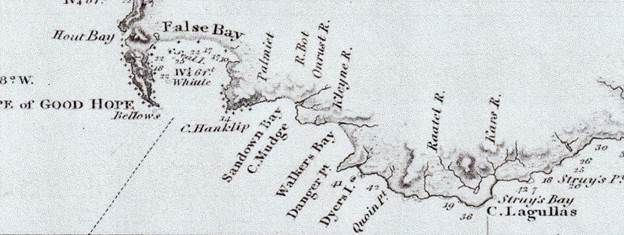
A map of the southeastern coast from 1822, probably the first map done after William Walker’s survey in 1818. Note the name Walker’s Bay.
Armed with that information Christopher turned to Jill Gerber’s 1998 study “The Archives of the East India Company and Southern Africa: A guide to the Archives of the East India Company and the Board of Control, 1600- 1858”. In the minutes of a meeting of the Committee of Shipping held on 29 July 1818 it is recorded that consideration was given to a letter to the Committee from William Walker RN, (W.W. “A” ) commanding HM Store Ship Dispatch, submitting for approval a manuscript chart of the southeast coast of Africa from Cape of Good Hope to Algoa Bay and a plan of the River Knysna. It was resolved that it be referred to Captain Horsburgh, one of the foremost maritime surveyors of the day, and that “he be desired to report thereon”.
On 19 August 1818 the minutes show that Captain Horsburgh attended the committee’s meeting and spoke highly of the utility of the two works, and that: “Mr Walker’s chart of southeastern Africa and his survey of the River Knysna … have been executed with much care and experience; and that the chart, if engraved, would prove a valuable addition to the Marine Atlas, supplied to EIC ships, and that the survey of River Knysna, if engraved, might be of use if that River affords place of shelter for ships of moderate size. The Committee resolved that the charts be engraved in the usual way.
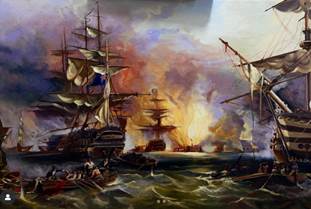
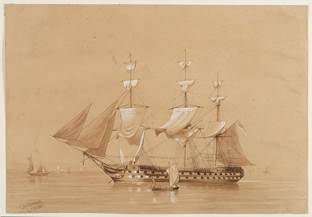
In trying to find out more about this William Walker, Christopher also referenced O’Byrne’s Naval Biographical Dictionary (a well-known 19th Century Dictionary of Naval personnel), which listed two Officers by the name of William Walker. The first William Walker, (W.W. “B”) was ruled out in Christopher’s view by service elsewhere during the critical years of the Survey in 1818, but the second seemed to fit. This was William Walker RN, (we’ll call him W.W. “C”)who entered the Royal Navy’s service on 29 January 1807 as Midshipman on board the frigate HMS Psyche (depicted in an illustration to Christopher’s article). He went on to serve in several significant colonial engagements and received his Commission in 1816. As we will see below, this guess did not turn out to fit the evidence!
Christopher’s article goes on to note some biographical details about William Walker (still W.W. “A”) in Walker’s own words from published sources:
In giving evidence to a Commission in 1861 he described himself as follows:
“Went to sea in 1797 in the Mercantile Marine and served 10 years in it, then to the Royal Navy. Commanded her Majesty’s Steamship “Despatch” five years but have had separate charge and Command of some 40 ships at sea in the Royal Navy of every class of sailing as a Master Attendant. Pretty well acquainted with the coasts of the United Kingdom and of Europe, also with the Cape of Good Hope navigation.”
From the information discovered to this point, Christopher found Walker (W.W. “A”) had written a training manual on use of compasses on board ship, The Magnetism of Ships and the Mariner’s Compass (1853) and he wrote about his time on HMS Despatch in this book:
“In February 1817 the author was appointed to command HM Storeship Despatch to be employed in the conveyance of naval timber from a forest on the south-east coast of Africa to the dockyard at Simon’s Town Cape of Good Hope. In this vessel he made fourteen trips round Cape Aguilhas (sic) …”
So, we see that William Walker (W.W. “A”) commanded HM Storeship Dispatch between 1817 and 1821, was later promoted to the rank Commander, and became first Master Attendant (responsible for securing navy vessels in port) and later Queen’s Harbour-Master at Devonport, Plymouth. From the title page of his book, we know that he was also Examiner in Navigation and Seamanship, a member of the Marine Board, Plymouth.
In November 1819 William Walker (W.W. “A”) applied to the Secretary of State for the Colonies for the potential post of Harbour Master of Knysna should such a post be contemplated, citing his survey of the coast from the Cape of Good Hope to Algoa Bay, and the River Knysna, while conveying timber to Simon’s Town. The post, however, was not created.
Thus far with Christopher’s article on our website.
In the meantime, the Hermanus History Society was incorporated into the Overberg U3A as the Overberg U3A History Interest Group (HIG) early in 2025.
Complicating query from abroad, and the plot thickens.
In July 2025, the HIG received an email from Mr. Tony Gould of the UK, saying that he had read with interest the fascinating article on our website by Christopher Barends revealing that “William Walker RN was the ‘Walker’ of ‘Walker Bay”. It came to light that Tony was not only a keen amateur genealogist, but also that a Commander William Walker RN, KTS was his 3-x great grandfather, and that he had been researching him for several years. This ancestor was the first of the two William Walkers listed in O’Byrne’s Naval Biographical Dictionary, and Tony had come to believe that this man was the Walker of Walker Bay, on the basis that he believed his ancestor (W.W. “B”) was the author of The Magnetism of Ships! He thus concluded that Christopher had taken the wrong William Walker from the List for his article.This was news to us at the HIG!He went on to say that he had obtained a copy of William’s book The Magnetism of Ships and was aware of his journey to South Africa in HM Store Ship Dispatch but knew nothing of the connection to Walker Bay. He also mentioned that he had seen watercolours that William had painted on that journey that were kept in the UK National Archives. Unfortunately, copyright prevents us from illustrating those watercolours.
The HIG Committee tried to contact Christopher to help clarify the matter, but without success. When we learnt that Christopher was also in the UK, we requested Tony to try and contact him and resolve their different conclusions.
To the rescue – further digging by Christopher.
In October 2025 Tony confirmed to us by email that he and Christopher had discussed the matter and following further research together they had concluded that neither of the officers listed in O’Byrne’s dictionary was the Walker of Walker Bay! The William Walker (W.W. “A”) who commanded the HM Store Ship Dispatch around the coast of South Africa, surveyed and charted the area and was later the Harbour Master of Plymouth in the UK and wrote the book “The Magnetism of Ships”, was neither of the two William Walkers listed in O’Byrne’s naval biographical dictionary – in fact he was not listed at all!
Instead, he was the William Walker (W.W. “A”), who we had identified earlier. He became a lieutenant in 1814 and a commander in 1850. This was confirmed by Christopher when he discovered (W.W. “A”)’s Royal Navy service record, which lists his time served on the HM Store Ship Dispatch.
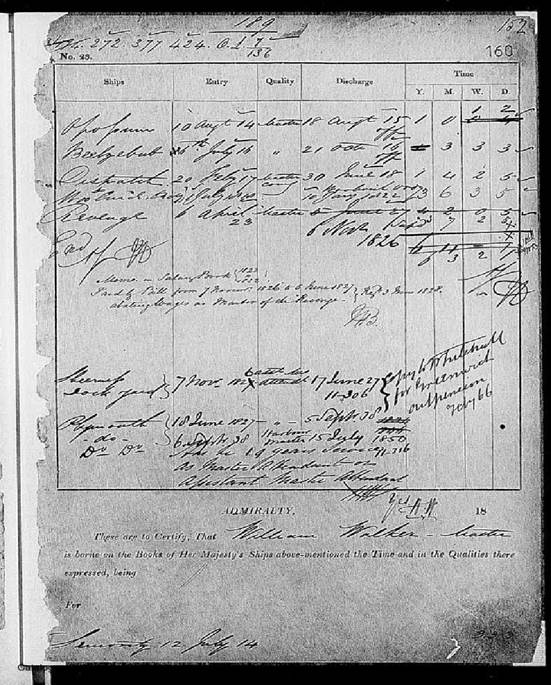
Cmdr. William Walker’s official service record in the RN. The other three ships he served on were HMS Opossum, HMS Beelzebub, and lastly HMS Revenge, all as Master(2nd in command to the captain). Note his artistic signature.
Finally.
Tony expressed his disappointment, because it would have been lovely to have had a personal connection to Walker Bay but said he was pleased that the record could now be set straight. Christopher added that what complicated the matter was that there were in fact at least five officers in the Royal Navy by the name William Walker at the time! Finding the RN service record of “Dispatch’s” Walker was the key to unlocking the mystery.
Some research by us revealed further evidence regarding Cmdr. William Walker and his HM Store Ship Dispatch. Did he survey the coast as far as Algoa Bay? He did, as recorded in the publication “Port Elizabeth of Yore”: We quote: “It was eventually Capt. William Walker, of the HM Store Ship Dispatch, who took up the cudgels regarding the dangers from the submerged rock which he named Dispatch Rock. In January 1818 he wrote a special report which he sent directly to the Commanding Officer of the Cape Naval Station, Admiral Sir Jahleel Brenton to have Despatch Rock [as it was sometimes incorrectly spelt] noted on charts and have a buoy placed on it. The Navy did publish a Notice of the danger in the press, but it neglected to arrange the attachment of a buoy.”
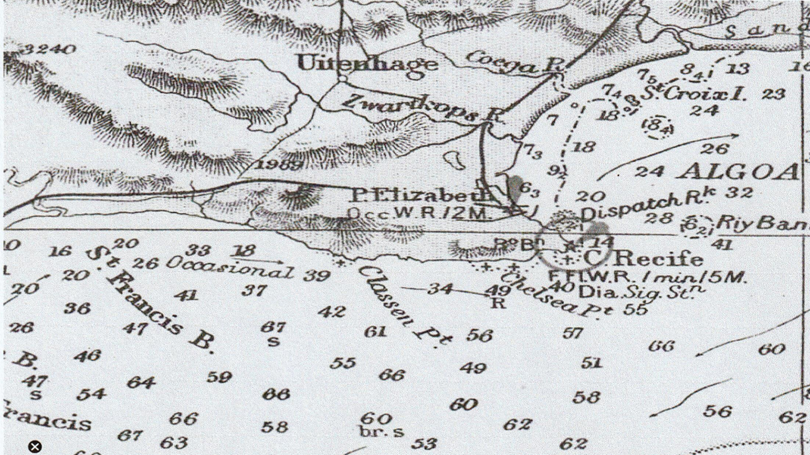
Map of Algoa Bay dated 1867 showing “Dispatch Rock” – today also called Roman Rock
CONCLUSION.
With the advice of Messrs. Christopher Barends and Tony Gould above at hand we concluded as follows:
Master W. Walker RN, who surveyed Walker Bay in 1818 was in fact Cmdr. William Walker RN, (W.W. “A”) who joined the Royal Navy in 1807 as an experienced navigator and received his commission as a Master on 12 July 1814. He served as Master on HMS Opossum, HMS Beelzebub, HM Store Ship Dispatch, and subsequently on HMS Revenge. He was then employed as Master Attendant (responsible for securing navy vessels in port) at Sheerness Naval Dockyard before transferring to the same role in Plymouth in 1827 where he was promoted to Harbour Master in 1838 and remained till 1850. He was also Examiner in Navigation and Seamanship, and a member of the Marine Board, Plymouth and the author of “The Magnetism of Ships and the Mariner’s Compass (1853)” and of course the chart “South East Coast of Africa, with a plan of the River Knysna (1818).” On his retirement he was promoted to the rank of Commander on 26 June 1850.
Summary of information from written records of the man after whom Walker Bay was named:
- Joined the Mercantile Marine in 1797 and served for 10 years, specializing in navigation.
- Joined the Royal Navy in 1807 as an experienced navigator and served as Master on HMS Opossum and HMS Beelzebub, before being given command of the HM Store Ship Dispatch in February 1817.
- In Dispatch his instructions were to convey naval timber from the forests of the south-east coast of Africa to Simon’s Town.
- Though there is no evidence that his instructions included surveying the coast, he did exactly that. In addition, he painted several watercolours of the south-east coast, notably the Knysna Heads.
- On 29 July 1818 he submitted by letter to the Committee of Shipping a manuscript chart of the coast from the Cape of Good Hope to Algoa Bay for consideration.
- The minutes of the meeting of the Committee of Ships of 19 August 1818 reveal that William Walker’s chart and plan were approved for engraving and issue to EIC ships.
- In his book The Magnetism of Ships he writes about his time on HM Store Ship Dispatch (although he refers to it as “Despatch”).
- In giving Evidence to a Commission in 1861 he describes his service in the Mercantile Marine and then the Royal Navy in HM Store Ship Dispatch.
- In a letter of 19 November 1819, he applied for the potential post of Harbour Master of Knysna on the strength of his chart and plan.
- His official written Service Record in the Royal Navy.
- His signature on several watercolours done by him on his trips along the south-eastern coast of Africa appears to be the same as his signature on his official Service Record.
- In January 1818 he wrote a special report, which he sent directly to the Commanding Officer of the Cape Naval Station, Admiral Jahleel Brenton, to have Despatch Rock (as it was sometimes incorrectly spelt) noted on charts and have a buoy placed on it.
For those readers that are still uncertain as to who is who – we list the names of at least five Walkers who served in the Royal Navy at that time:
- Cmdr. William Walker, our man from the HM Store Ship Dispatch. (W.W. “A”)
- Cmdr. William Walker, KTS. (1828). (W.W. “B”) who served on the HMS Windsor Castle. He is Tony’s ancestor.
- Cmdr. William Walker RN, (W.W. “C”). This gentleman entered the Royal Navy’s service on 29 January 1807 as Midshipman on board the frigate HMS Psyche, depicted in an illustration as part of Christopher’s article on our website.
- William Walker, a Surgeon in the RN.
- William Walker, a Marine in the RN
With grateful and special thanks to Tony Gould and Christoher Barends, both from the UK, for their extensive and meticulous research into the question as to the name of the man after whom Walker Bay was named. Without such dedication the resolution of the question and thus this article would not have been possible. Thanks to Michael Clark and his wife Christa for the maps and artwork on the photographs, and to Dr Robin Lee who initiated this exercise.
Jack van Dyk o/b/o The Committee of the Overberg U3A History Interest Group – January 2026.
References.
- Books by local historians Arderne Tredgold, Jose Burman and S J du Toit.
- “Narrative of Voyages to Explore the Shores of Africa, Arabia and Madagascar.” by William Fitzwilliam Owen, 1833, referring to a bay to the east of Cape Hangklip lately discovered by Mr. Walker, a Master in the Navy.
- “The India Directory, or Directions for sailing to and from the East Indies” 6th Edition 1852, by Captain James Horsburgh, RN, with extensive references made re comments and notes on coastal features and dangers on the southern coast of the Cape by a William Walker.
- “South East Coast of Africa, with a plan of the River Knysna by Mr. William Walker RN, 1818” 1851 catalogue of charts and surveys produced by the East India Company. House of Commons, August 1851. Volume 2 page 659.
- “The Magnetism of Ships and the Mariner’s Compass”. 1853, by William Walker, Cdr, RN. Referring to the time of his command of HM Store Ship Dispatch on the south-east coast of Africa.
- “The East India Company and Southern Africa: A Guide to the Archives of the East India Company and the Board of Control, 1600-1858” Jill Louise Gerber. Noting the submission of a manuscript chart and plan by William Walker to the Committee of Shipping on 29 July 1818.
- “Minutes of the Committee of Shipping of 19 August 1818 resolving to approve the chart and plan of the south-east coast of Africa submitted by Mr. William Walker. https://discovery.nationalarhives.gov.uk/details/r/C9668689.
- Letter of 18 November 1819 from Cmdr. Walker to the Admiralty applying for the potential post of Harbour Master of Knysna.
- “Report of the Commissioners Appointed to Inquire into the Condition and Management of Lights, Buoys and Beacons” –1861. HM Stationery Office, Volumes1-2. Evidence given by Cmdr. Walker about his career at sea.
- “The Navy List”, John Murray, 1951. Page 38. Lists William Walker (W.W. “A”) as retired and gives date of promotion to Commander as 26 June 1850 and date of commission as Master as 12 July 1814.